Thursday, 2 March 2017

Workplace and Locally Developed Learning Activities

Hello all!

I cannot believe that this will be my last post for EDBE 8F83! Soon we will be off to our second and third teaching blocks, and I cannot believe how fast this year has gone by. It feels like we were just in September starting our Teacher's College journey.

This week in class we finished off presentations with Workplace and Locally Developed Learning Activities. The activities that were presented were very practical and followed a fun and exciting format.

The first presentation was done by Jenny, who focused on Grade Eleven Workplace. This activity was to have students plan a trip such as bowling or the movies. Each student was given a worksheet with the following steps:
Image result for bowling
Retrieved from http://saionline.ca/event/bowling-and-burgers-night/

1. Budget
2. Destination
3. Transportation
4. Cost of Activity
5. Food and Beverages

This activity was particularly great because of how practical it was for students. Often in mathematics students find themselves wondering how the math they do in class could ever relate to the real world. But this activity provides students with an activity that relates directly to their world. This is something that students may already be doing; planning a trip based on budget, destination, transportation, cost and food.

Image result for adventure
Retrieved from http://www.thisworldexists.org/blog/how-to-adventure
The next activity was presented by Courtney and focused on Grade Ten Locally Developed Mathematics. Her activity was similar to Jenny's, but instead of planning a day trip students were asked to plan an adventure. This wasn't limited to a day trip, and could have many different possibilities. The activity started with picking three departure time cards and three arrival time cards. The first task was to calculate how long each of the three trips would be. Next we picked one of those trip times, and had to plan an adventure based on those times. Our adventure could be any activity of our choice, but we had to use at least one form of public transit. I thought this activity was so much fun and gave students a lot of freedom in planning their adventure.

Image result for clapping
Retrieved from https://goo.gl/o4ZMz8
The last presentation was done by Teagan who focused on Grade Nine Locally Developed Mathematics. Her activity was focused on Breaking a World Record and Proportional Reasoning. We watched a video of a guy clapping very fast for 4.5 seconds and had to make a prediction of whether or not he would break the world record of 721 hand claps in one minute. In 4.5 seconds he clapped 63 times. We needed to use our proportional reasoning skills to make a prediction. My group used cross multiplication and guessed 840 claps in one minute. We were then shown a second video that showed the same guy clapping 485 times in 35.9 seconds. This second video allowed us to make a more accurate prediction of 810. In the end, he did beat the record with 802 claps. I thought this activity was awesome and was something that would really interest Grade Nine students.

Overall, these activities all had a common thread. They were all practical, real world activities. They were activities that students would find interesting and useful in their own lives.

Thursday, 23 February 2017

Senior College and Workplace Preparation Learning Activities

Hello everyone!

This week in EDBE 8F883 we were presented with learning activities that were geared towards Grade Eleven College and Grade Twelve Workplace Preparation. One thing that I noticed was common between these presentations was the practicality of the activities. These activities were not only fun, but were useful beyond the Mathematics field.

The first presenter was Kyle who showed us a learning activity that we could use in Grade Eleven Foundations for College Mathematics (MBF3C). This activity covered the Personal Finance strand and was centered around Compound Interest and Credit/Debit transactions. He started with a short review of compound interest using the SMART board. The main activity was to tell us that we were all buying a TV priced at $2000.00 and we had to decide which credit was the better deal. Each group was given a different Credit or Debit card and asked to calculate the interest, any bonuses (Cashback, etc.) and the total cost. After each group did our calculations, we were asked to write our answers on the SMART board. This was a great visual to see the differences between the different cards that were available.

Something that I thought was really great from Kyle's presentation was the addition of a "Catch" on some of the cards. Our card, for example, was the best deal because it provided Cashback but this was only available for the first four months of owning the card. Therefore in the long run this card may not have been the best deal. I thought this was an awesome addition to the activity because it made it more like real life. A lot of times in math we create problems that have perfect solutions, but that usually isn't the case in life. By adding a Catch on some of the cards, you are giving students a taste of what may happen if they actually go out and get a Debit/Credit card of their own.

The other presentation that I will be talking about is Heather`s activity on Proportional Reasoning from Grade Twelve Mathematics for Work and Everyday Life. Each group was given a floor plan and told we needed to redo the floors. We were also given a selection of samples of different types of flooring, each with a price per square foot. Based on how much square footage we had in each room, we had to calculate how much it would cost to install a certain kind of flooring.

This activity was so much fun and my group got so into picking the different types of flooring. As an extension, we were also asked to pick paint and calculate how much it would cost to paint certain rooms in our house. I think that students would find this activity extremely engaging because it combines mathematics with something more creative.


Overall, both these activities showed that learning activities can have a practical side to them while teaching important mathematical concepts. These activities made connections to real world problems and activities that students will more than likely encounter after they have left high school.

Thursday, 16 February 2017

Grade Twelve University Learning Activities

Hello everyone,

This week in EDBE 8F83 we were presented with learning activities that focused on Grade Twelve curriculum. The three courses that were presented on were Advanced Functions (MHF4U), Calculus and Vectors (MCV4U) and Data Management (MDM4U).

The first activity that we saw was Logarithm Dominoes which was designed to be used in Advanced Functions. Shannon framed the structure of the lesson as having a warm up, lesson, activity, and consolidation (which was usually group work). After a brief explanation, Shannon handed out the dominoes and an instruction sheet. The idea of the game was instead of having numbers on them, the dominoes had logarithms that we had to solve while playing. For the sake of time, we worked together as a group. (As you can see in the picture to the right, all our dominoes are facing up) The game started with a double in the middle of the table. Then we took turns placing dominoes next to the ones already placed. If a player could not play during their turn, they were required to pick up a domino from the stack facing down. The objective of the game was to get rid of all your dominoes first.

At first my knowledge of logarithms and log rules was a little sketchy, but as we worked through the game I was able to remember quite well. I really enjoyed how this game incorporated math skills but was also fun and exciting at the same time. I could definitely see Grade Twelve students loving this game.

The second presentation was given by Lucas who focused on Calculus and Vectors by doing an activity called The Falling Meter Stick Problem. This problem was a little difficult at first, because its been a very all time since I've done high school Calculus, but the instructions were easy to follow and eventually our group got it. One thing that I would have liked to see during this activity was a demonstration of the meter stick falling. It might have been better for visual learners to see it rather than having to imagine it. Something that I enjoyed from this activity was the worksheet that we were given. It was easy to follow and gave students enough space to work.


The last presentation was presented by Jodi and focused on Data Management. The activity that she showed us was Deal or No Deal and was aimed to teach probability to students. The idea of the game was to mimic the TV show. We started by picking one number to be our briefcase. Then there was a series of rounds in which we would pick cases to eliminate and receive a deal from the banker. After each round we were asked to decide if we were going to take the deal or not by using probability.

I really enjoyed playing this game and my group got very into the excitement of it all. I could absolutely see Grade Twelves loving this game and thinking it is fun. Data Management can tend to be boring for students so this game can put some excitement into the mathematics.

Overall, these three activities showed that Grade Twelve mathematics can be so much more then writing a note everyday and doing homework. It is possible to incorporate games and activities into a University bound classroom, you just have to have some creativity.


Thursday, 9 February 2017

Grade Eleven Learning Activities

This week in Math Education class we were presented with learning activities for Grade Eleven math classes. We were presented with activities for both the University (U) and the Mixed (M) stream.

Stafanie was the first to present and her learning activity was focused on Grade Eleven M course, Functions and Applications. Her activity focused on the consolidation portion of the lesson and required students to make review booklets based on Exponential Functions.The booklets were labeled with five different sub-headings and under each heading students would write down key points and concepts. I really enjoyed this idea and felt that I could use it in my future classroom by making it my own. If I was to use this idea in my classroom, I would have each student complete a booklet after each unit. These booklets could even be put onto a piece of paper four at a time and placed in the front of binders. They would be a great asset to students who may struggle with studying or creating good study material. These would also be a great tool to use when students are completing review questions because they can't see any of the answers while they are working, they are forced to think about what the concept is.

The second presenter was Gordon who taught us about constructing triangles. The course he focused on was Grade Eleven U, Functions. Something that I took away from his presentation was the triangle tool pictured to the left. What I really enjoyed about this tool was that I could use it to visualize the ambiguous case for students. This particular tool was made to show the Side-Side-Angle (SSA) relationship. If given two sides and one angle, a student should be able to construct one, two or no triangles.When I taught Grade Eleven Functions at my placement in December, this was a concept that students really struggled with. Even I found myself struggling to wrap my head around this concept. But after seeing this tool in action, I am confident that it would have helped my Grade Elevens understand this concept so much better. By being able to manipulate the triangle and see the yellow arm move to form the two different triangles students are given a visual representation. This is very important because a lot of students have a hard time when it comes to visualizing problems in trigonometry.

Lastly, Laura presented a great way to introduce exponential functions to Grade Eleven U students. She set up three stations around the room and split us up into groups. As groups we rotated around the room to complete each station. The first station was a Zombie Apocalypse which involved a hoard of zombies infecting the city. The second station was the Ice Bucket Challenge and the third station involved folding a sheet of paper. All of these stations modeled exponential functions. We each received a worksheet that had a table of values to record the data and a graph. I think this was a great activity to get students thinking about exponential functions and what they look like. I also enjoyed how the end of the worksheet contained questions about first and second differences, showing that these functions were neither linear nor quadratic.

I look forward to next week when we dive into Grade Twelve Mathematics.

Thursday, 2 February 2017

Grade Nine and Ten Applied Activities

Hello all!

Can you believe that another week has pasted and we are already into February of 2017? Time really does fly...

Related image
Image retrieved from https://goo.gl/V6kvUP
This week in EDBE 8F83 we were presented with Grade Nine and Ten Applied learning activities. I presented my learning activity this week, which was a Grade Ten Applied activity from the
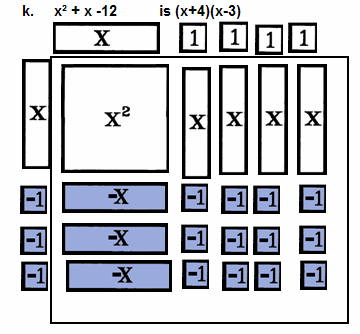
Quadratic Relations of the form y = ax² + bx + c strand. I was specifically focusing on the overall expectation "manipulate algebraic expressions, as needed to understand quadratic relations" and the specific expectation "factor simple trinomials of the form y = ax² + bx + c, using a variety of tools and strategies". The activity was a consolidation activity used to check understanding of factoring simple trinomials. I split the class into five groups and gave each group a trinomial and an incorrect solution. Students were instructed to correct the solution using algebra tiles and paper and pencil methods. Overall the activity went over well and I was happy with the result. One thing that I would have done differently is explain the proper use of the algebra tiles more effectively. I explained how to use the algebra tiles when the trinomial has all positives but I did not explain how to do this with negatives. It worked out okay for my presentation because our class is filled with teacher candidates that all took at least three university mathematics classes. My colleagues were able to infer how to how to use them, but Grade Ten Applied students would have struggled. Other than this small hiccup, I was very satisfied with my presentation. 

One other presentation that also went this past week was Rachelle's activity which had a Grade Nine Applied focus. Her activity used the TI-83 graphing calculators and the CBR (motion sensor attachment). This activity was used to teach linear relations and it was awesome. I really enjoyed being able to use the CBR to make connections between the graph and my physical motion in front of the sensor. I think this will be a great activity to use with students because they will benefit from the visual of actually being able to form their own graphs. I also liked that we (as the students) were so involved in the activity. Rachelle was constantly getting us to come up to the board or the document camera and contribute to the activity. This is a great habit to get into as a teacher. This gives students many opportunities to get engaged in the lesson, and really learn something.

After these presentations and having time to reflect on my own future classroom, I think that it is important to know your learners and focus your activities on how they learn. Most likely a typical class will have a mixture of learners in it. This means that incorporating many different types of instruction is important. Visual learners may really like algebra tiles because they give a great visual representation of trinomials. While kinesthetic learners may benefit from the CBR because it allows them to get up and move around the room. Depending on the nature of your learners, you can tailor your activities to them!

Thursday, 26 January 2017

Grade Nine Academic Learning Activities

Hello everyone,

This week in EDBE 8F83 we focused on learning activities that were aimed at Grade Nine Academic classes. That being said, I believe that these activities could be modified to function in many different math classrooms.

Image result for red heart
Image retrieved from https://goo.gl/E9HJJf
The first presentation that I really enjoyed was Melissa's Speed Dating and Equation Making activity. This activity was set up like a typical Speed Dating session would be set up; pairs of people facing each other. Each person had one classmate sitting across from them. Each student was given a handout sheet with space to write the name of each partner you meet. The students on the inside were given a y-intercept and the students on the outside were given a slope. Each time there was a rotation, the students were required to use the information they had between the two of them to create an equation of a line and graph that line. The fun part came after the students had graphed the line. If the line that was created went through a red heart, that meant that your partner was your "Match". I found this incredibly fun and it almost took the pressure of the math off. I think this would be a great activity for grade nines because it is more of a game that includes math, rather then math that is kind of a game. Additionally, as Melissa suggested, I think that this activity format could be used in different classes as well. It could be used in a Grade ten class for quadratics, a Grade 11 class for sinusoidal functions, or a Grade 12 class for more advanced functions.  I also really enjoyed that the students were getting up out of their seats and moving around. This is an activity that I will 100% be using in my future classroom.

The second activity that I enjoyed was presented my two of my colleagues, Bevan and Lindsey. These were two separate presentations, but they both did the same topic. What was interesting to see was the different styles of teaching that could be used when teaching just one topic.

For Lindsey's presentation she used a Lab Format, in which she gave students many different materials and asked them to investigate the formula for the Sum of the Angles of a Polygon. This was a great activity to see how students explore and collaborate with each other. I enjoyed having the freedom to solve the problem whichever way I wanted to. This is great for students because not every student is going to solve it the exact same way. I appreciated that this activity gave students that freedom.

For Bevan's presentation he used a more Guided Format to present the Sum of the Angles of a Polygon. He took as through the investigation process as a class. We started with drawing triangles within the polygons. We were instructed to create the smallest number of triangles that we could. Following this part, we flipped our sheets over and started filling out a chart to investigate the sum of the angles. I thought is activity would be great for an applied class or a class that typically needs a little more guidance.

I really enjoyed seeing the difference between these two activities. It really shows that depending on the nature of your class, the instruction needs to change. This is known in the education world as Differentiated Instruction, or commonly known as DI. DI can be defined as "effective instruction that is responsive to students’ readiness, interests and learning preferences". By knowing your students and how they learn, you can choose an appropriate instruction style. This instruction style could be one of the three that we saw this week or something completely different. It all depends on how your students learn best.

Thursday, 19 January 2017

Grade Seven and Eight Learning Activities

Welcome back everyone!

This week in EDBE 8F83 we started our Leading a Learning Activity presentations. This week focused on mathematics from Grade 7 and 8. Although I do not see myself as a Grade 7 or 8 teacher, it was great to see different ideas and think about how I would incorporate them into my classroom. Additionally, as a secondary school teacher it is good to have knowledge of the Grade 7 and 8 curriculum. When I teach Grade 9 mathematics I am going to have to think about what my students learned in previous years. So having knowledge of grade 7/8 and having a few activities in my back pocket can become a huge asset.

Image result for game of life money
Image retrieved from https://goo.gl/F1M3AA
The first presentation that I want to comment on is Dayna's grade 7 activity called "The Game of Life". The activity consisted of splitting the class up into five groups and calling each group a family. Each family is given a monthly income and a list of expanses that they will have to pay for. I thought this idea was a great way to not only teach mathematical concepts but to incorporate financial literacy into the classroom. Financial literacy can be described as "having the knowledge and skills to make responsible economic and financial decisions with confidence". This is something that is mandated by the Ministry of Education to be included in every Ontario course so it is important to consider. Through this activity students learn the importance of saving, paying bills and responsible money management. Additionally this activity is a great way to bring up topics such as diversity and how different families often have very different financial situations (as Dayna mentioned in her presentation). I would absolutely consider incorporating this activity or something similar into my classroom. Depending on the class I was teaching, I may have to make modifications but overall I could definitely see myself using this activity in my classroom.

Image result for holes movies
Image retrieved from https://goo.gl/Azbyiu
The second presentation that I want to talk about is Nam's Grade 7/8 "Holes Activity". Nam's activity focused around a clip from the movie Holes, where there is a conflict between two characters, Stanley and X-ray, regarding a shovel. Stanley's shovel was 5ft while X-rays shovel was 4ft 11inches. Given that each hole that is dug is a cylinder, and has a diameter and height the same as the length of the shovel, a problem was posed. The problem that was posed to the students was; "What is the volume of soil that each boy will dig using his shovel?". This was a great visual for students to be able to get a "real-life" example of geometry and volume. I loved how he used a movie that students were familiar with and could be interested in. This could easily be modified depending on the interests of my students. I would love to use this kind of activity in my own classroom. I think a story is a great way to hook students and get them interested in the math you are trying to teach them.

I look forward to seeing the many more exciting and useful presentations that my colleagues have to share!

Until next week, cheers.